[BOT Report]
//.
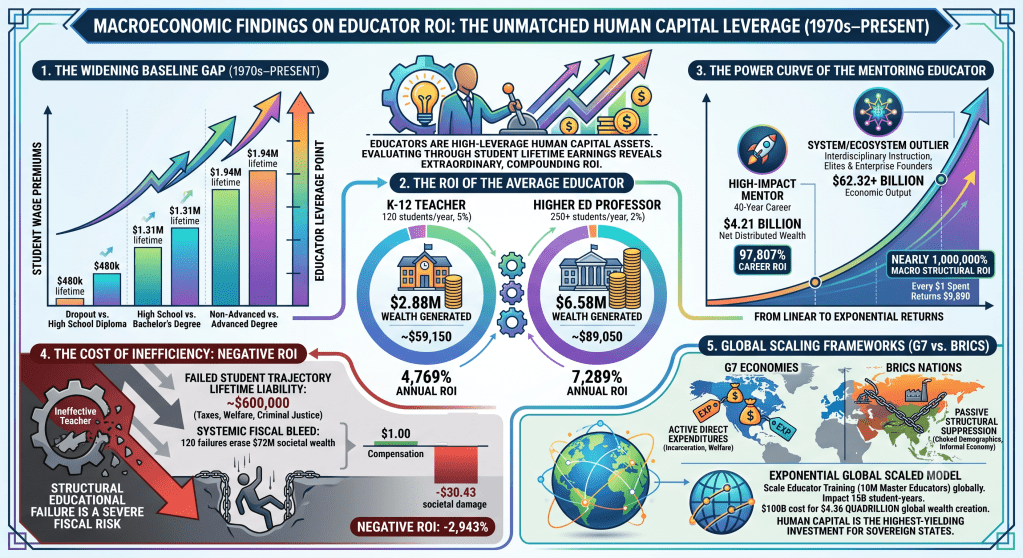
This progression of financial modeling illustrates how educational outcomes shift from predictable, linear wage premiums into compounding, non-linear wealth generation systems. By analyzing the data through different lenses—national baseline tracking, structural attribution, and elite mentorship modeling—we map the true return on investment (ROI) of human capital development.
/
Phase 1: National Baseline Trends (The Widening Educational Divide)
- The Baseline Reality: Between 1985 and 2025, nominal earnings grew across all tiers, but the structural polarization between educational cohorts permanently locked in.
- High School vs. Dropout Premium: The annual graduate premium expanded from +$4,100 (1985) to +$12,100 (2025), representing a $480,000 lifetime earnings delta per capita.
- College vs. High School Premium: The absolute annual gap for 4-year degree holders accelerated dramatically, moving from +$9,200 (1985) to +$32,900 (2025)—accounting for an average $1.31 million lifetime divergence.
- Terminal/Advanced Degree Insulation: Specialized professional credentials (M.D., J.D., Ph.D., Master’s) yielded the highest delta, hitting an annual premium of +$48,500 by 2025, which generates $1.94 million in lifetime value over those without an advanced degree.
//.
BOT reports use extensive original research, Google tools, Adobe tools, MS-Office, and original coding to synthesize graphics and text for public engagement.


Leave a Reply