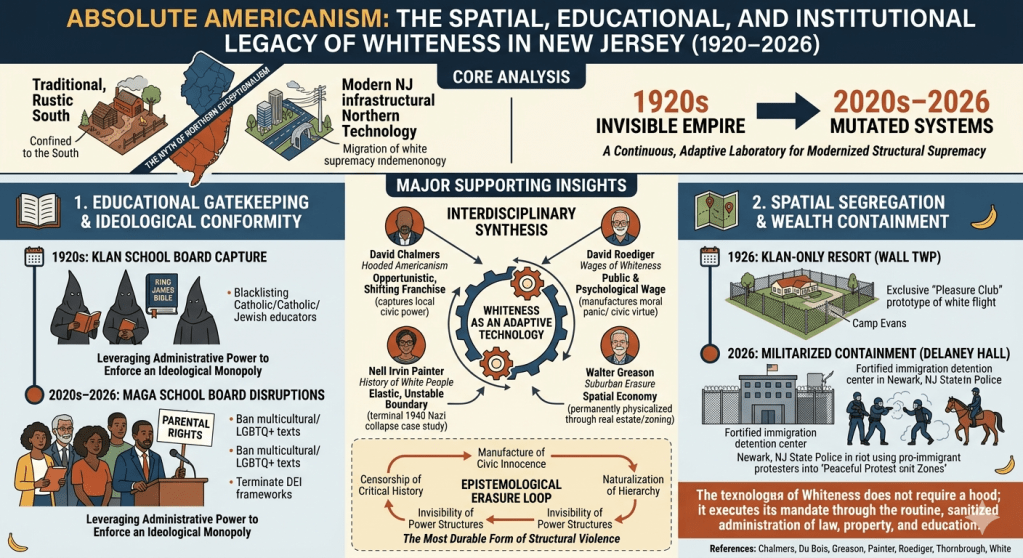
The deep origins of the paramilitary actions by state and federal police have roots in the Ku Klux Klan in New Jersey.
Absolute Americanism: The Spatial, Educational, and Institutional Legacy of Whiteness in New Jersey (1920–2026)
Introduction: The Myth of Northern Exceptionalism
The popular understanding of white supremacy in the United States routinely suffers from a profound geographical and structural reductionism. For generations, the historical imagination has confined the mechanics of explicit racial terror and institutionalized xenophobia to the agrarian landscapes of the American South. In this truncated narrative, the Mason-Dixon line functions as a clean moral boundary. The American North—and the Mid-Atlantic region in particular—is conversely framed through a lens of progressive exceptionalism, cast as an urbanized, industrial, and inherently multicultural bastion that successfully resisted the virulent, explicit white supremacist movements of the Reconstruction and Jim Crow eras.
This historical amnesia does not merely obscure the past; it fatally compromises our capacity to analyze the present. Racial hierarchy in America has never been a static regional pathology. Instead, it operates as a highly adaptive, institutional, and spatial technology that continually migrates, commercializes, and reformulates its rhetoric to capture dominant structures of civic power.
In his foundational text, Hooded Americanism: The First Century of the Ku Klux Klan, historian David M. Chalmers systematically dismantles the myth of Northern immunity. Chalmers documents how the “Second Klan” of the 1920s—re-engineered as a modern, corporate, and fraternal enterprise—achieved its most formidable and lucrative triumphs not in the rural swamplands of Mississippi, but within the rapidly industrializing, urbanizing, and suburbanizing corridors of the American North and West.
Nowhere was this shifting transformation more vivid, or its long-term institutional legacy more enduring, than in the state of New Jersey. Under the aggressive leadership of Grand Dragon Arthur H. Bell, a former vaudeville performer turned legal and financial architect, the New Jersey Realm of the Knights of the Ku Klux Klan synthesized mass entertainment, fraternal consumption, and commercial real estate speculation into a potent empire of what they termed “100% Americanism.”
To fully comprehend the structural durability of Bell’s project, however, Chalmers’s exhaustive institutional data must be cross-examined with and elevated by critical race historiography. The institutional history of the Klan cannot be fully understood in a vacuum; it must be mapped onto the shifting socioeconomic architecture of “whiteness” itself. The seminal scholarship of David Roediger, Nell Irvin Painter, and Walter Greason provides the precise theoretical scaffolding required for this analysis.
Together, these theorists demonstrate that whiteness is not an immutable biological category, but an artificial, legally protected, and economically incentivized technology designed to secure property, discipline labor, and entrench socio-political hegemony. David Roediger’s formulation of the “public and psychological wage” of whiteness explains how working-class identity was racialized to prevent cross-racial labor solidarity. Nell Irvin Painter’s diagnosis of the “elastic boundaries” of the white race illuminates how dominant groups expand or contract the definition of who counts as “white” to maintain political majorities. Walter Greason’s paradigm of the “spatial economy” and “suburban erasure” reveals how racial privilege is permanently physicalized and protected through real estate investment, zoning, and geographic segregation.
When this interdisciplinary framework is applied to the trajectory of New Jersey from 1920 through 2026, a striking institutional continuity stands exposed. Over the course of more than a century, the strategies for preserving white structural dominance in the state have consistently relied on two primary operational pillars:
- The co-optation of educational institutions and local governance to police the ideological boundaries of the citizenry.
- The strategic alignment with law enforcement and state power to control physical, geographic space.
From the coastal “Klan resorts” and school board takeovers of the 1920s to the contemporary MAGA-led disruptions of public school infrastructure and the militarized state police containment of public protests at detention facilities like Delaney Hall, the architecture of whiteness in New Jersey has evolved its language while keeping its structural objectives perfectly intact.
This essay will trace that century-long evolution. By integrating Chalmers’s empirical history with the critical insights of Roediger, Painter, and Greason, it will demonstrate how the modern battles over public school classrooms and municipal space are not disconnected outbursts of modern polarization, but the direct, structural descendants of an institutional lineage established during the interwar zenith of the Invisible Empire.


Leave a Reply