The Root Word: Language and the Sacred (10 October 2026)

[BOT report]


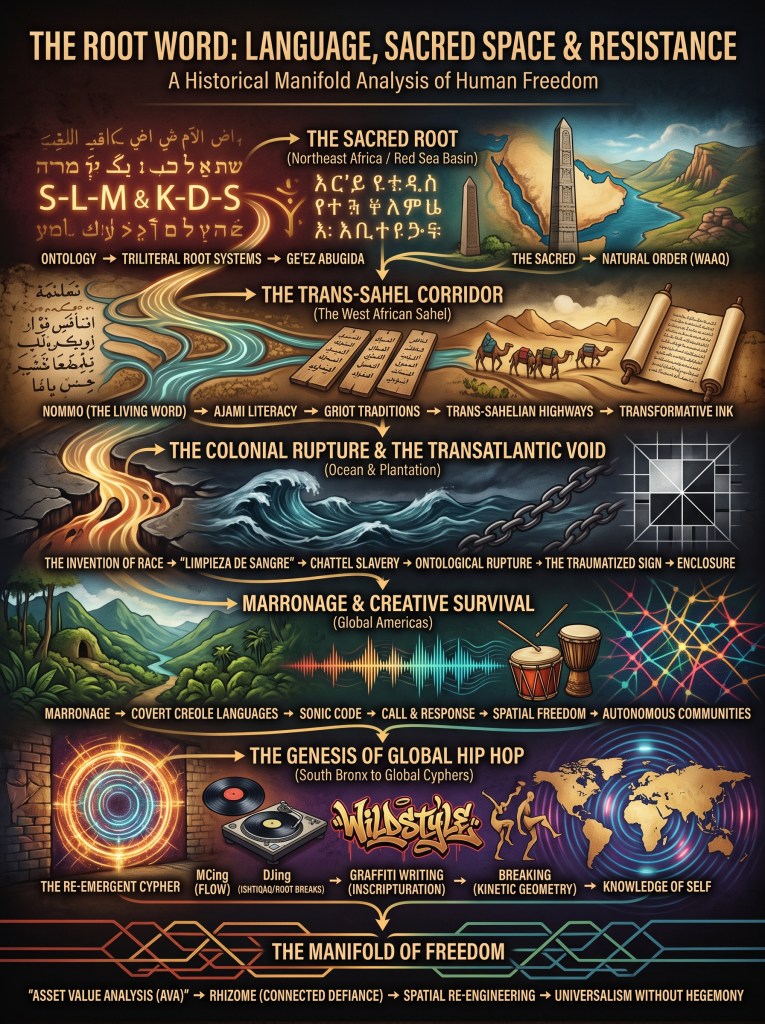
The story of human identity, power, and survival is at its core a story of how
communities construct meaning from the raw materials of sound, geography, and
memory. Long before the modern era invented fixed classifications to divide
populations, ancient societies organized their place in the universe through language.
The spoken and written word was not merely a passive medium for daily
communication; it was an active, generative force—an ontological technology that
brought cosmic order to physical landscapes.

/
From the trade winds of the Red Sea and the vast savannas of the Sahel to the
traumatic ruptures of the Transatlantic slave trade and the concrete avenues of the
South Bronx, humanity has continuously deployed linguistic and musical expression to
resist imperial enclosure. When dominant empires sought to reduce human beings to
biological commodities, marginalized populations responded not with passive
resignation, but with a profound, multi-dimensional poetics of resistance. By examining
the deep historical continuum that connects ancient Afroasiatic root systems, Red Sea
scriptural traditions, Sahelian literacy, and the global emergence of Hip Hop, we

uncover an enduring blueprint of historical marronage—a continuous, spatial re-
engineering of human freedom.

BOT reports use extensive original research, Google tools, Adobe tools, MS-Office, and original coding to synthesize graphics and text for public engagement.


Comments

One response to “The Root Word: Language and the Sacred (10 October 2026)”

  1. Stephanie Croney Avatar
    Stephanie Croney

    As someone who teaches African American history, I often ask students to think deeply about the relationship between literacy and power. In Module 5, Literature, Literacy, and the Power of the Written Word, we explore the meaning of “the Word” in its most fundamental form. One question I pose is how we might understand John 1:1 (“In the beginning was the Word…”) in relation to the historical denial of literacy to enslaved Africans.

    The discussion extends far beyond religion. It invites us to consider the Word as a manifestation of divine breath, creativity, knowledge, and agency.If the Word carries sacred power, then access to reading, writing, and interpretation becomes more than an educational privilege. It becomes a means of human and spiritual self-determination. The systematic denial of literacy to enslaved Africans was therefore not simply a restriction of knowledge; it was an attempt to limit access to a powerful tool of self-definition, communication, and liberation.

    What I find especially compelling in your explanation is the idea of the mobility of the Word. It expands our understanding of how African-descended peoples have continually carried, adapted, and transmitted knowledge across generations, geographies, and historical conditions. Even when their voices were suppressed, their texts destroyed, or their literacy restricted, they developed ways to preserve meaning through oral traditions, storytelling, music, performance, memory, and eventually the written word itself. In this sense, the Word remained in motion. It traveled across time and space despite systems designed to erase or silence it. That enduring movement speaks to the resilience, creativity, and intellectual sovereignty of the African diaspora.

    Like

Leave a Reply