[LLM Report]
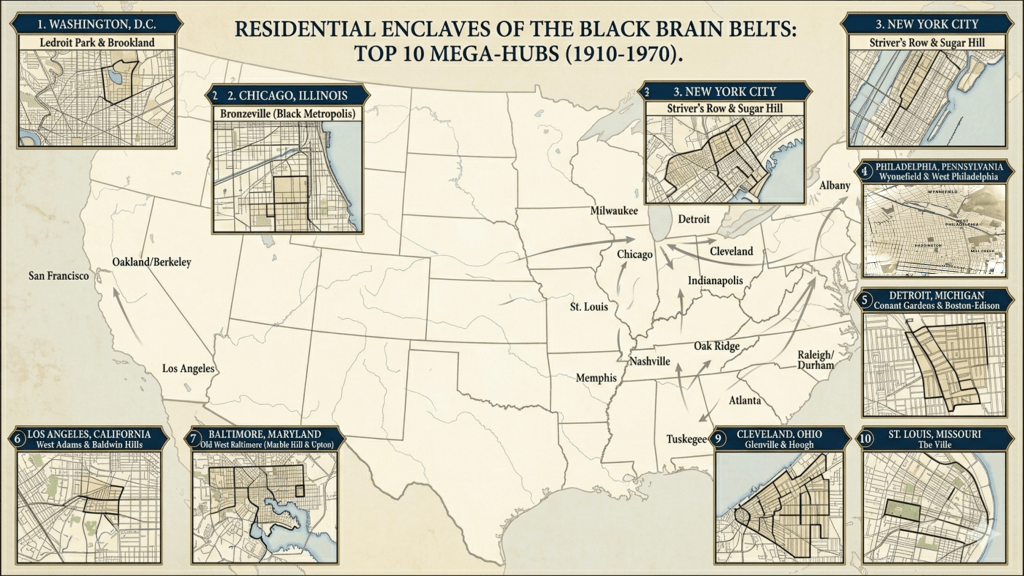
In the conventional historiography of the mid-twentieth-century Civil Rights Movement, the American North is routinely visualized through a stark urban lens. Academic and popular accounts focus heavily on industrial centers—the tenements of Harlem, the factory corridors of Chicago, the public transit systems of Detroit, or the deeply segregated wards of Newark. In these narratives, the suburbs, small towns, and rural fringes are frequently cast as monochromatic spaces of white flight, economic exclusion, and geographic homogeneity. Black populations in these spaces are often depicted as fragmented or structurally invisible, disconnected from the grand institutional engines of racial advancement.
/
Historian Walter David Greason shatters this conceptual dichotomy. In his foundational texts, Suburban Erasure: How the Suburbs Ended the Civil Rights Movement in New Jersey and The Path to Freedom: Black Families in New Jersey, Greason uncovers an entirely different sociopolitical landscape: the “rural corridor” and emergent exurbs of New Jersey. Greason’s economic and spatial analysis demonstrates that marginalized families systemically utilized local institutions—the family unit, the church, the segregated school, and the local community center—to forge autonomous enclaves of economic, intellectual, and cultural power. In these spaces, African Americans did not merely survive; they waged a sophisticated, quiet war against the structural mechanisms of racial capitalism and suburban segregation.
/
Nowhere was this phenomenon more potent than in Monmouth County, New Jersey. Centered around the historic municipalities of Red Bank and Wall Township, this geographic zone became an extraordinarily concentrated laboratory for Black institutional self-reliance and intellectual achievement. Far from being isolated anomalies of individual genius, the mid-century networks that emerged in this region—most visibly represented by the civil rights work of the Red Bank Men’s Club, the defense-era STEM interventions of the Camp Evans Tutors, and the global sonic revolution catalyzed by William “Count” Basie—were the direct, intentional manifestations of a century-long ideological continuum.
/
This essay traces how these seemingly disparate mid-century networks were rooted in the 19th-century philosophical architectures of Frederick Douglass and Alexander Crummell. It examines how these national frameworks were localized and operationalized at the turn of the century by radical journalist Timothy Thomas (T. Thomas) Fortune and his wife, Carrie Smiley Fortune, at their Red Bank home, Maple Hall. Ultimately, by utilizing Walter Greason’s theoretical model of spatial reclamation and institutional defense, this work analyzes how Red Bank and its environs functioned as a critical locus of Black history, showing that the fight for freedom was as much about mastering the physics of outer space and the rhythms of Big Band swing as it was about integrating public accommodations.
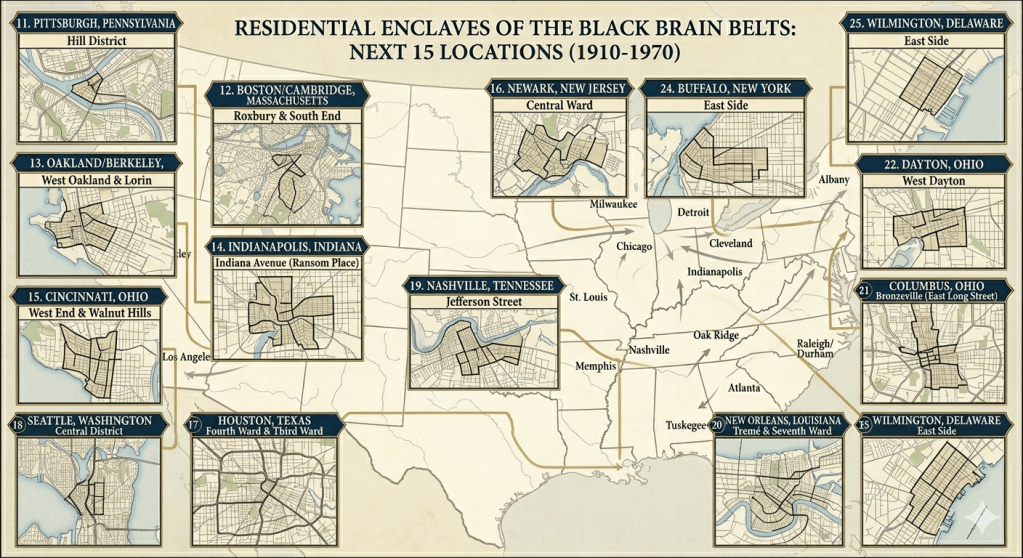
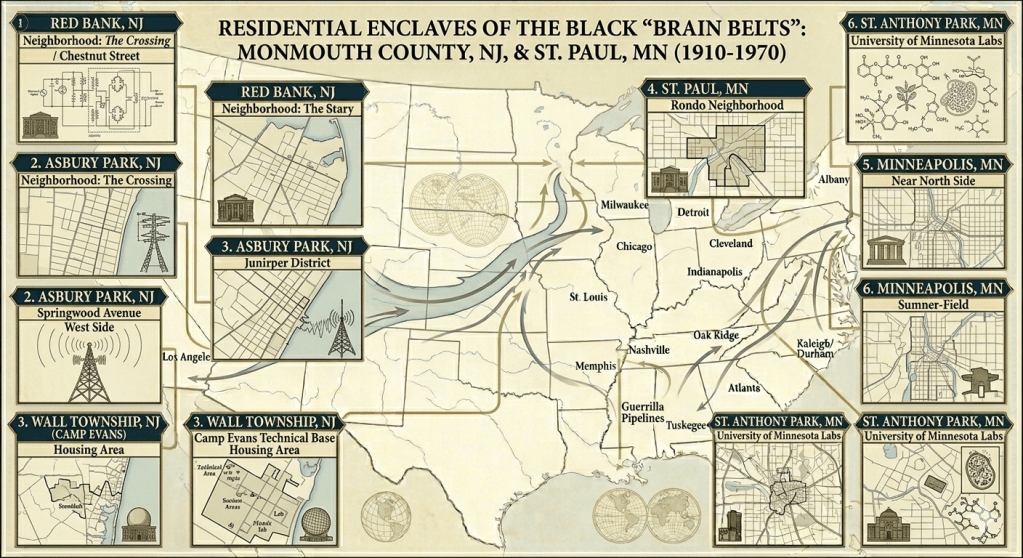
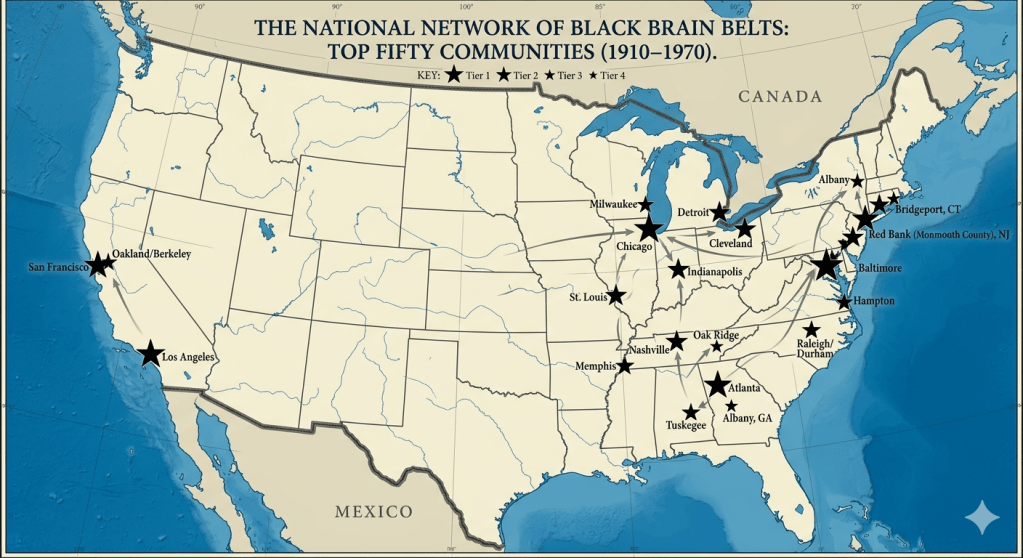
The Geography of Black Innovation, 1910-1970. “Black Brain Belts” existed across the United States based on previously undocumented levels of industrial and digital investment.


Leave a Reply