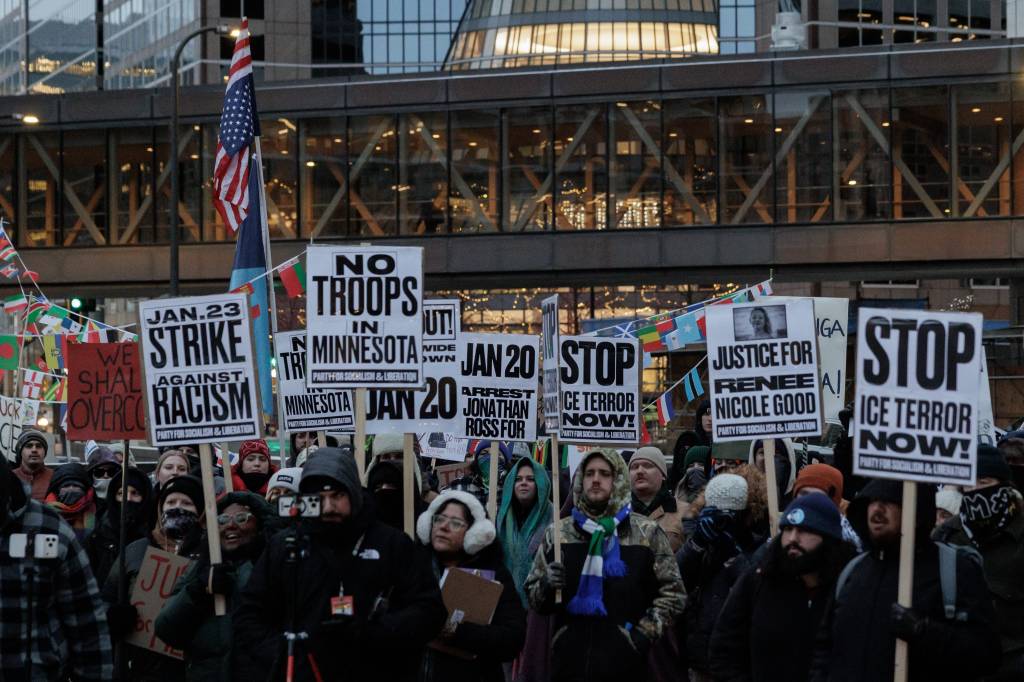
When you hear about the first shooting, the initial reaction tells the story about what happens next. Do you freeze? Do you run? Do you stand up? For me, after hearing about Renee Good’s murder on January 7, I checked with groups of local leaders and activists for their assessments. Almost everyone was stunned, but there were flashes of potential action. The news of the assault on students at a school followed almost immediately. Then, other people notified me that Saint Cloud had dozens of agents abducting people off the street. Within four hours, I reached out to every connection I had to mobilize community defense networks in every city in the state. Within two days, teams were operating in Minneapolis, Saint Paul, and Saint Cloud. Within five days, we successfully pressed the Governor’s Office and the Attorney General to file suit against the Department of Homeland Security. Then, the real work started.
In the first full week, it was apparent that the federal troops intended to overwhelm the state and create a sense of compliance with military occupation in Minnesota. Minute by minute communications were essential to give local Minnesotans the tools and expertise to defend themselves. We called for legal observers and journalists to travel to the state immediately to document the events. Mass media outlets were slow to respond. Independent and investigative journalists became the core of the reliable communications networks. Verified social media outlets provided important updates on paramilitary activities. As federal officials escalated their rhetoric, community groups distributed resources through mutual aid and mitigated the worst assaults on local neighborhoods.
The outreach for the strike on January 23 was the turning point. Organized to bring the state to a standstill and signal to the world that the federal government had abandoned the restraints of the United States Constitution, it was a day that had not occurred in seventy years. With tens of thousands of participants in Minneapolis alone, Minnesota spoke with one voice against the abuse of power we faced from Washington, D.C. Hundreds of simultaneous protests continued in other cities between January 23 and 25. In the midst of this disciplined uprising, tragedy struck again.
The murder of Alex Pretti by another sloppy group of untrained, paramilitary forces reinforced the global urgency to end the illegal occupation of Minnesota. A ransom letter from the Attorney General made the corruption at the heart of these actions obvious to all observers. Within a day, the outcry moved into elected leadership and set the agenda to remove the troops and cut the funding for these violent invasions nationwide. The immediate changes in the political leadership are not sufficient, but they laid the foundation for a total reversal of these enforcement policies. More importantly, the example of civil resistance in Minnesota has now offered a range of dynamic blueprints for use in the United States and around the world.
Several people have asked me as an historian, “how do we understand this moment?” It is a complicated inversion of the Secession Crisis in 1861. Where South Carolina attacked Fort Sumter and precipitated the creation of the Confederate states and the Civil War, the federal invasion of Minnesota was an attempt to use military force to coerce compliance in violation of the Constitution. It was an attempted ACCESSION – an effort to break a state to federal authority and turn Minnesota into Arkansas. Everywhere that the federal government attempts to use military and police power to demand that every city and state follow their policies is a trial about accession. They want to force a kind of assimilation to radical, fascist values and thinking at the point of the gun.
Worse, by attempting this project in Minnesota, it threatens a return to the jurisprudence of Roger Taney – broadly applied to any people who defy the conservative orthodoxy. It was Dred Scott’s claim that he became a citizen by traveling to Minnesota that provoked Taney’s Supreme Court to declare that a black person has “no rights that a white [person] is bound to respect” in 1857. This paramilitary project is designed to vacate the Fourteenth Amendment’s core promise that “equal protection of the laws” extended to every person in the United States. It is a frontal assault on the foundation of the Declaration of Independence that “all [people] are created equal.”
Minnesota has blunted this attack over the last few weeks. How much more must the world do in the weeks and months ahead to protect the ideas of freedom and democracy everywhere?


 Genius Locus
Leave a comment